The world around us is full of signs, lettering and visual messages that help us orient ourselves in space. For blind and partially sighted people, what is obvious to most of society becomes a challenge. Fortunately, advances in technology and growing public awareness are making space increasingly accessible. From simple but ingenious solutions like Braille to modern acoustic systems, the story of accessibility is the story of how, step by step, we are building a world open to all.
Braille - the beginning of accessibility
The Braille alphabet, created in the 19th century, was a breakthrough that allowed blind people to read and write independently. To this day nodules for the blind as Braille is present in lifts, on handrails, buttons or medicine packs. Although for many it is just invisible dots, for blind people it is the key to knowledge, information and freedom. It is where the revolution in creating accessibility began - showing that the world can be 'seen' by touch.
Textured surfaces and tactile markings
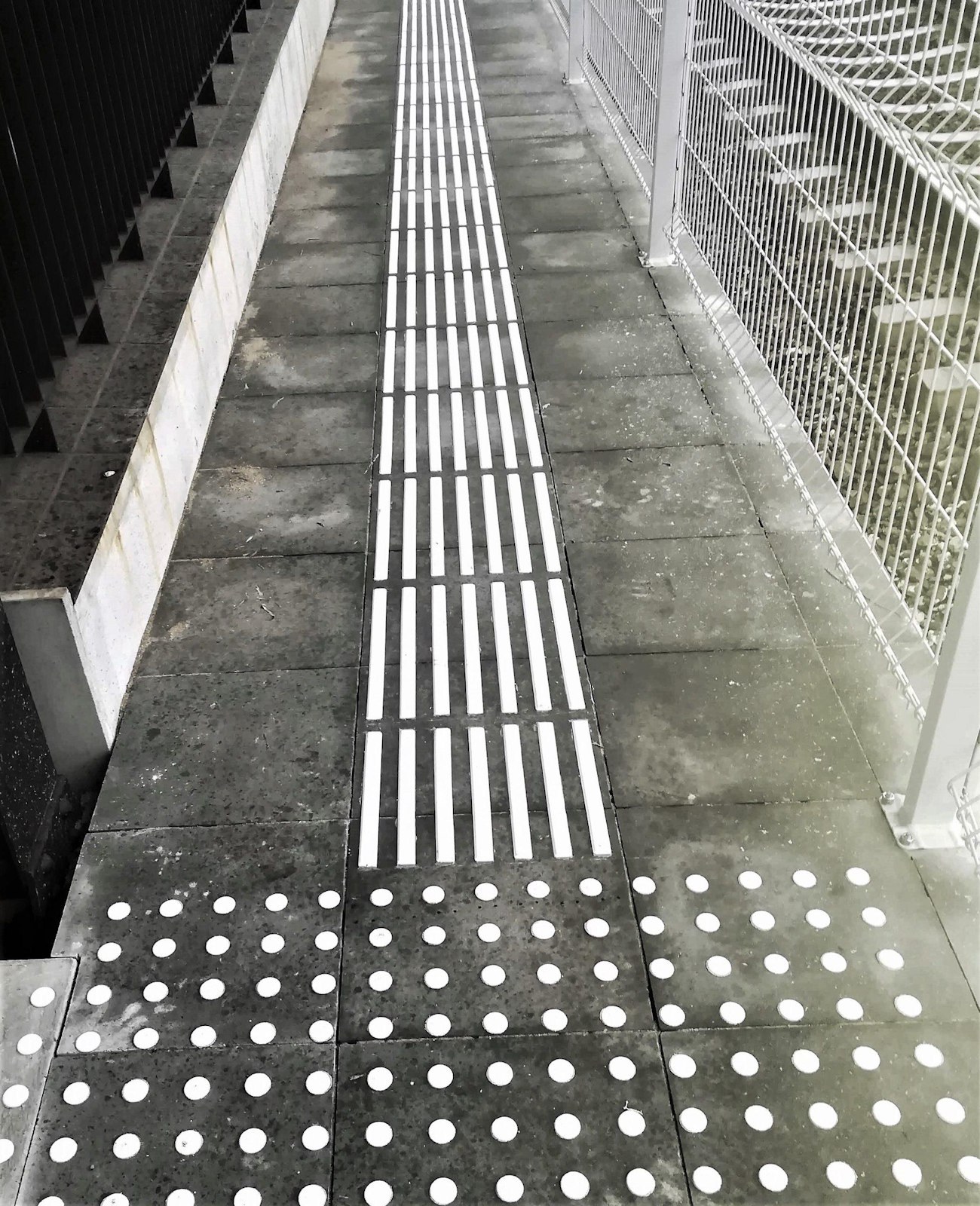
The next stage has been solutions in public spaces, such as tiles with tabs, guide lanes or warning boxes. This is a system that can be read with feet or a cane and that marks safe routes, signals stairs, pedestrian crossings or the edges of platforms. They enable blind people to use pavements, train stations or shopping centres independently and safely. Today, it is difficult to imagine a modern city without these elements, although they were rare until recently.
Visual contrasts - support for the visually impaired
Not everyone loses their sight completely. For visually impaired people, colour contrasts are crucial. Painting the edges of steps on stairs, marking platforms with clear colours or using dark and light stripes at crossings make orientation easier. These are simple, inexpensive and extremely effective solutions that often make the difference between safety and the risk of an accident.
Acoustic systems - sound as a guide
The real breakthrough, however, came with acoustic systems. Acoustic signalling at pedestrian crossings, voice announcements on trams, buses and subways or acoustic guides in public buildings make it possible for blind people to use transport and infrastructure with ease. What's more, modern technology makes it possible to adapt sound intensity to the surroundings, making the systems even more user-friendly and functional.
Integration with modern technology
Today, accessibility does not stop with Braille, contraptions and tactile signage. Intelligent navigation systems that link the physical and digital worlds are becoming increasingly important. Mobile applications that work with Bluetooth beacons, audiodescription in museums or special beacons at public transport stops are solutions that allow blind people to be even more independent. This proves that technology can be not only practical, but also profoundly humane.
Social value of accessibility
Each Signs for the blind - from a sign in Braille to a voice application - is not only a technical support, but also a symbol of concern for equality. An accessible space is one in which everyone feels safe and has the right to move around freely. Investing in such solutions is not a luxury, but a necessity that enhances the quality of life for the entire community.
The future of accessibility
Developments are moving towards the full integration of technology and space. We can expect to see even more advanced acoustic systems, smart pavements that react to the presence of the user or devices that provide real-time information about the environment. Each step like this is further evidence that the world is moving towards greater openness and solidarity.
Summary
From Braille to acoustic systems, the development of accessibility is a fascinating story that shows that true modernity is not just about technology, but above all about sensitivity and empathy. Thanks to tactile signage, visual contrasts and innovative sound systems, blind people can use spaces on an equal footing with others. This is proof that, step by step, we are creating a world where everyone has the right to independence and a safe path to their destination.


