
For many people, a car that stops running automatically becomes a 'wreck' - that is, something useless, redundant and destined for the mill. However, the truth is quite different. Even the most worn-out car has surprising potential. In practice, parts that are apparently only suitable for scrap metal gain a second life - not only as spare parts, but also as... designer furniture, household appliances, works of art and even industrial tools.
So let's take a look behind the scenes of the junkyard and see how parts from dismantled cars end up in completely unexpected places and play completely new roles.
Second-hand parts - a market that is booming
Let's start with the most obvious, but still underestimated application: aftermarket spare parts. Vehicle dismantling stations not only accept cars for scrapping, but also select and recover reusable components.
What is most likely to hit the secondary market?
-
engines and transmissions,
-
alternators, starters, compressors,
-
headlights, mirrors, windows,
-
seats, dashboards, steering wheels,
-
rims, suspensions, on-board electronics.
Through careful testing and selection, many of these parts can be re-installed in other vehicles - and at an attractive price. This not only saves the owner money such as Auto scrap Ropczycebut also a real reduction in the consumption of raw materials and energy needed to produce new components.
Industrial replacements - technical and workshop applications
Some car parts, though, are no longer suitable for reuse in vehicles, are ideal as components in other technical constructions.
Examples from workshops and industrial plants:
-
suspension springs used as shock absorbing components in machinery,
-
bearings and joints transformed into moving parts of equipment,
-
fuel lines and brake pipes used as flexible hydraulic lines,
-
Coolant reservoirs as storage tanks for pressurised systems.
It is not uncommon for parts from scrap cars to gain new functions in an industrial environment - often in completely unpredictable ways.
Furniture and interior design - style with an automotive flair
This is where the real fun begins. Lovers of industrial design and upcycling can create out of scrap car parts unique furniture and decorationswhich attract attention and give the interior a unique character.
Here are some inspiring examples:
-
car bonnet desksbased on a metal frame with suspension elements,
-
sofas from the back seats of luxury cars, upholstered anew but retaining the original belts and headrests,
-
headlamp lampsmounted on steering column stands,
-
coffee tables made of steel rims, with toughened glass as a top,
-
shelves and shelving made of baseboards or metal body parts.
Such items often find their way into offices, workshops, lofts and motoring pubs. They are not only functional, but also full of history and unique style.
Arts and crafts - a second life in creative form
There is also no shortage of artists who use scrap metal as the material for their works. Combining metal, plastic and glass, they produce artistic installations, sculptures, garden ornaments and many other forms.
Examples of projects:
-
animal sculptures made from body parts and silencers,
-
paintings and mosaics of parts of the dashboards,
-
modern hangers from converted seatbelts,
-
wind chimes from pistons and valves.
Some of these works end up in exhibitions, others find buyers as 'eco-industrial' style handicrafts. Whatever their form, they have a common denominator: they show that seemingly useless waste can become a source of creativity.
Material recycling - the invisible transformation
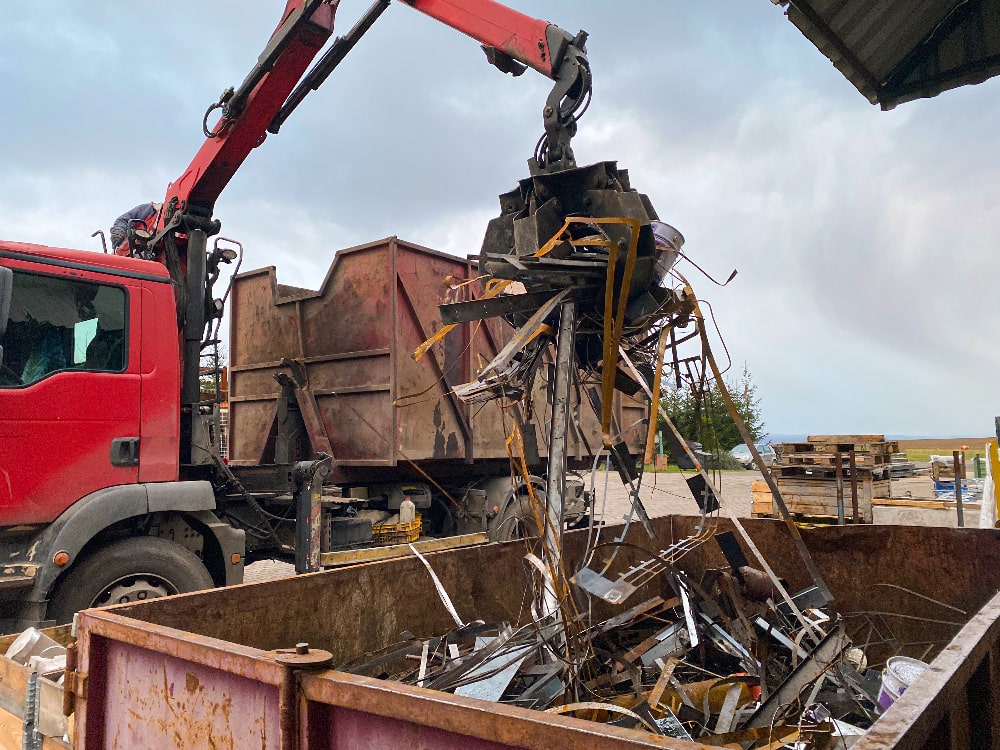
Not all parts can be reused in their entirety, but almost all can be recycled. Material recycling allows raw materials to be recovered, which are returned to the industry in a new form.
Examples:
-
Aluminium from rims and radiators goes back to the smelters and is used to make window frames, cans or new automotive parts,
-
steel from the car body is used in the construction industry, e.g. for steel profiles,
-
Once recycled, plastics become housings for household appliances, garden furniture or transport pallets,
-
Glass from glazing is used as an additive to asphaltenes or as an insulating material.
All this means that virtually any material from a scrap car can be used - without the need to extract new raw materials.
Bottom line - a wreck? I don't think so!
A car that stops running does not stop being useful. On the contrary, it becomes a storehouse of raw materials, parts and inspiration. From the used parts market, to industrial applications, to art and design, the possibilities are almost endless.
It is therefore worth looking at Car scrapping Debica not as an end, but as a start of a new cycle. By returning the car to a legitimate dismantling centre, you not only get rid of the problem, but give the materials a chance for another life - sometimes in a form that no one would expect.


