
Flooding in a house or flat is a situation that can take even the most preventive owner by surprise. A burst pipe, sewer back-up, heavy rainfall, washing machine breakdown - the sources of the problem can be many. Water does not choose - it penetrates walls, seeps through floors and reaches foundations. However, it is not the end of the world. Even severe flooding can be brought under control and the building can be restored to full functionality. You just have to act quickly, sensibly and in accordance with technical principles.
In this article we explain step by step, how to effectively save walls, floors and foundations after floodingwhich actions are key, what to avoid and when it is not worth acting alone.
Flooding - safety first
Make sure your home is safe before you do anything:
-
disconnect the current in a flooded room - especially if the water reaches sockets or electrical appliances,
-
close the water supplyif the cause is an installation fault,
-
remove mobile equipmentwhich may further damage or contaminate the water.
Only when you are sure that there is no risk of paralysis or flooding can you move on to rescue operations.
Stage 1: Water removal and surface drying
This is an absolutely essential first step. The water must be removed as quickly as possible - the longer it remains in contact with the building materials, the deeper it penetrates and the more difficult it is to evaporate afterwards.
What to do:
-
use submersible pumps, water hoovers or buckets - depending on the level of flooding,
-
Dry surfaces of visible water with squeegees and cloths,
-
Switch on the ventilation as soon as external conditions allow.
At this stage, it is not enough just to dry the floor. Water may already have penetrated under the floor, into the layers of polystyrene, into gaps in the insulation or under the wall cladding - and this is where the main danger lies.
Stage 2: Diagnosis - what was really left damp?
Once the water has been removed, it must be thoroughly assess the extent of moisture. This is the moment to enlist the help of specialists. A professional dehumidification company will carry out:
-
moisture measurements of walls, floors, floors and insulation layers,
-
analysis of places that are difficult to access (e.g. under a spout),
-
assessment of the condition of horizontal and vertical insulation.
This makes it possible to select appropriate dehumidification methods and assess whether the structural components in question require repair, replacement or just dehumidification.
Stage 3: Structural drying - walls, floors, foundations
Wall dehumidification
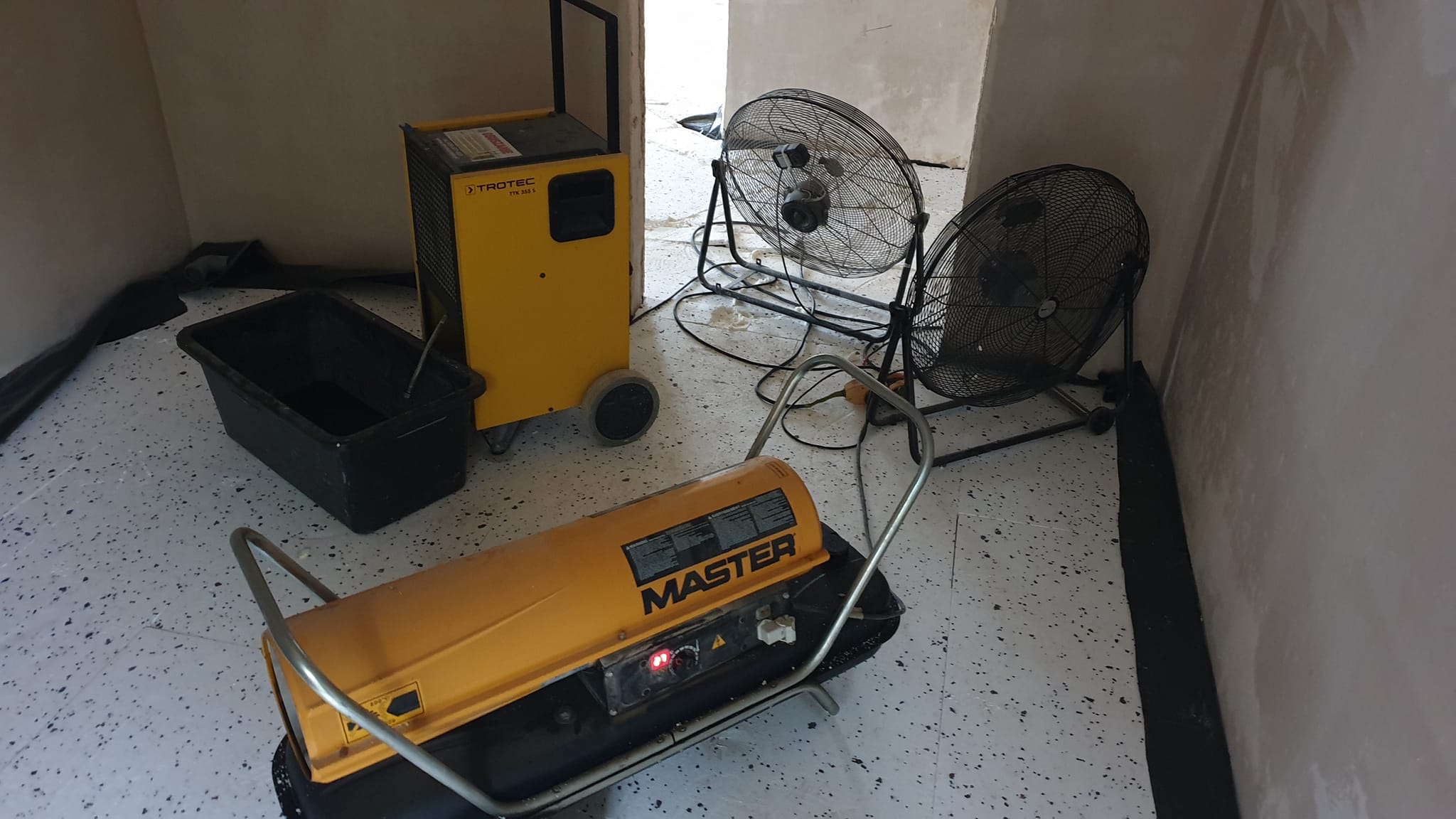
Depending on the degree of moisture, the following are used dehumidification after flooding Warsaw (for surface moisture) or microwave/adsorption (for deeper moisture). Dehumidifiers run for several to several days - as long as it takes for the material's moisture content to drop to a safe level.
Floor and floor drying
The biggest challenge is posed by so-called floating floors, where moisture gets between the layers: screed, insulation, polystyrene, foil and finishing layer. This is where underfloor dehumidification (positive pressure or vacuum) is used, which injects or sucks in air, pushing moisture out from under the surface.
Dehumidification of foundations
Flooding can damage the vertical and horizontal insulation of the foundations. In such cases, the following applies:
-
ground drying,
-
excavating and securing from the outside,
-
crystalline injection - creating a new, permanent moisture barrier.
It is also worth doing thermographic surveysto check that the foundations have not been thermally or mechanically damaged by prolonged contact with water.
Step 4: Cleaning, disinfection and protection
Water, especially dirty or sewage water, can introduce fungi, bacteria and viruses into the building, which threaten the health of the occupants. Therefore, once the structure has been drained, you need to:
-
disinfect surfaces chemically or thermally,
-
remove mouldy or infected materials (e.g. fragments of plaster, wallpaper, skirting boards),
-
use of antifungal preparations,
-
carry out waterproofing.
This stage is of great importance for health and prevents recurrence of problems.
Stage 5: Renovation and final inspection
Only after it has been fully dried and disinfected can the actual renovation work begin: plastering, painting, laying new floors or replacing joinery.
Before you do, however:
-
perform control humidity measurement - only the dry surface is suitable for finishing,
-
ensure that the cause of flooding has been permanently removed,
-
consider installing moisture sensors or a monitoring system.
It is also worth planning prevention: better ventilation, airtight seals, improved damp-proofing, especially in basements and on the ground floor.
What to avoid after flooding? Popular mistakes
-
Waiting for it to dry on its own - Without structural drainage, water can persist for months.
-
Moisture sealing under the new finish coat - leads to cracking, mould and the separation of materials.
-
Use of domestic heaters and dryers - They raise the temperature but do not remove moisture from the walls.
-
Skipping disinfection - Moisture after flooding is an ideal environment for microorganisms.
Summary - fast action, professional technology, long-lasting effect
Building flooding is a difficult but not hopeless situation. Modern technologies dehumidification of flats Warsaw and the experience of specialists make it possible to successfully salvage even severely soggy structures - as long as we act quickly and comprehensively enough.
The key is to remove the water, diagnose the condition, apply appropriate drying methods and monitor the effects. Only on this basis can restoration proceed. In this way, your home will not only regain its former appearance, but will also be safe, healthy and ready for years to come - without unpleasant surprises with damp in the background.


